
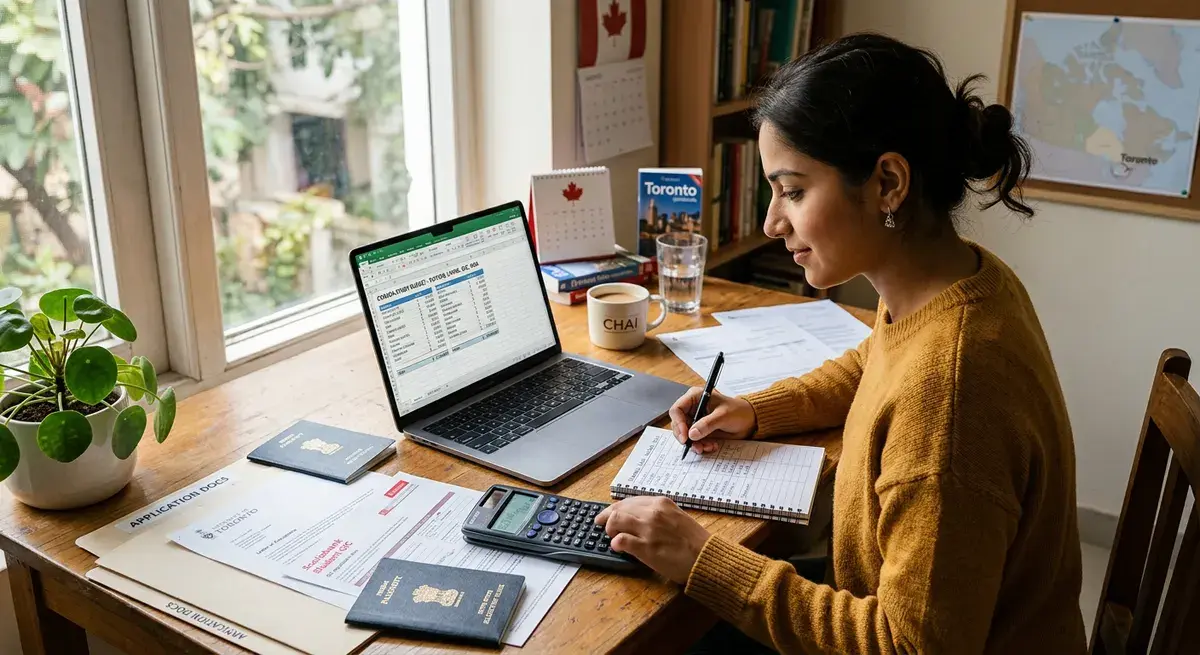
If you are planning to study in Canada, one of the most important parts of your study permit application is proving that you can financially support yourself. The Canadian government, through Immigration, Refugees and Citizenship Canada (IRCC), requires students to demonstrate sufficient funds for living expenses, tuition, and travel.
Starting September 1, 2026, IRCC has updated the minimum financial requirement for new study permit applicants. For a single student, the minimum living-expense requirement has increased from $22,895 CAD to $23,448 CAD per year, in addition to tuition and travel costs.
This article explains what the change means for Indian students, what you need to show, and how to prepare your documentation so your application is not delayed by avoidable mistakes.
What Does Proof of Funds Mean for a Canada Study Permit?
Proof of funds is the documentation you provide to IRCC to show that you have enough money to pay for your tuition, living expenses, and return travel — without needing to work illegally or relying on public funds in Canada.
IRCC does not set a single minimum bank balance figure. Instead, you must demonstrate enough funds to cover three components: living expenses (the minimum amount set by IRCC per year), your tuition fees (as stated by your university), and your return travel costs.
The living-expense amount is the part that has changed. Starting September 1, 2026, the minimum for a single student is $23,448 CAD per year. This applies to all provinces and territories except Quebec, which has its own financial requirements.
The New Financial Requirement Effective September 1, 2026
The updated amounts effective September 1, 2026 are as follows:
For a single student (no accompanying family members): $23,448 CAD per year for living expenses, plus your full tuition fees and return travel costs.
If family members are accompanying you, the required living-expense amount increases. Check the IRCC website for the current amounts based on your family size.
These amounts are in addition to your tuition. If your programme costs $20,000 CAD per year in tuition, your total proof of funds for a single year would be approximately $23,448 (living) + $20,000 (tuition) + travel costs. Plan for the full duration of your study, not just the first year, unless you can show continued income or savings.
Who Does This Apply To?
The updated proof-of-funds requirement applies to new study permit applications submitted on or after September 1, 2026. If you applied before this date, the previous amount ($22,895 CAD) applies to your application.
The requirement applies to most study permit applicants, with some exceptions — for example, students who have already been studying in Canada with a valid study permit may not need to re-demonstrate funds for continuation, but should verify their specific situation with IRCC.
If you are applying from India for the first time, or re-applying after a gap, you should plan based on the updated amounts.
What Students Typically Need to Show Besides Tuition
Proof of funds is not just about showing a bank balance. IRCC looks at the overall financial picture to assess whether you can genuinely support yourself. Besides tuition, you typically need to demonstrate:
- Living expenses: At least $23,448 CAD per year for a single student (updated amount from September 1, 2026).
- Return travel costs: The cost of travel to and from Canada. IRCC does not set a fixed amount, but you should account for reasonable flight costs.
- Bank statements: Typically from the last four months, showing a consistent available balance — not a sudden large deposit just before your application.
- Source of funds: If someone is sponsoring you (a parent, for example), include their bank statements, proof of employment or business, income tax documents, and a sponsorship letter.
- Guaranteed Investment Certificate (GIC): A GIC covering the living-expense amount is a common and credible way to demonstrate funds, particularly through the Student Direct Stream (SDS) application pathway.
Why Budgeting Early Matters
Many students focus on getting an admission offer and leave the financial planning for later. This is a mistake. Your proof of funds is a core part of your study permit application — if it is not credible, your application can be refused regardless of how strong your admission offer is.
Budgeting early means you have time to: organise your bank statements over several months rather than rushing a large deposit at the last minute; arrange a GIC if you are using the Student Direct Stream; gather sponsorship documentation if a parent or relative is funding your studies; and account for the full programme duration, not just the first year.
Students who plan their finances early tend to have smoother application experiences and fewer delays. Students who rush often face refusals or requests for additional documentation that can push their timelines.
Common Mistakes in Financial Planning
The following mistakes appear frequently in Canada study permit applications from Indian students. Most are avoidable with early planning.
- Showing only the minimum amount: IRCC may question whether the minimum is genuinely sufficient for your specific situation. Showing more than the minimum, where possible, can strengthen your application.
- Sudden large deposits: A bank statement showing a sudden, unexplained large deposit just before the application is a common reason for refusal. IRCC expects to see a consistent balance over several months.
- Not explaining the source of funds: If a sponsor is funding your studies, their financial documents should clearly show the source of the money — employment income, business income, savings, or other legitimate sources.
- Forgetting travel costs: Students sometimes account for tuition and living expenses but forget to include return travel costs in their proof of funds.
- Using an education loan without proper documentation: If you are using an education loan, ensure the loan documentation is complete, current, and clearly states the disbursed amount.
- Not accounting for the full programme duration: If your programme is two years, showing funds for only one year may not be sufficient unless you can demonstrate continued income or savings.
How Students Should Prepare Their Documentation
Strong documentation is the foundation of a successful study permit application. Here is a practical approach to preparing your proof of funds:
- Start early: Begin organising your bank statements and financial documents at least four to six months before you plan to apply.
- Maintain a consistent balance: Avoid large, unexplained deposits. If you receive funds from a sponsor, document the source clearly.
- Use a GIC if possible: A Guaranteed Investment Certificate from a participating Canadian financial institution is a credible way to show your living-expense funds, particularly through the SDS pathway.
- Gather sponsor documentation: If a parent or relative is funding your studies, collect their bank statements (last four months), income tax returns, proof of employment or business, and a sponsorship letter.
- Include tuition proof: Provide your university acceptance letter and fee receipt showing the tuition amount for your programme.
- Account for travel: Include a reasonable estimate for return travel costs in your financial planning.
- Keep everything current: Ensure all documents are recent — typically within the last four months — at the time of application.
What Indian Students Should Do Before They Apply
Before you submit your study permit application, take the following steps to give yourself the best chance of a smooth process:
- Confirm the current IRCC proof-of-funds amount on the official IRCC website — do not rely on second-hand information.
- Calculate your total required funds: living expenses ($23,448 CAD/year for a single student from September 1, 2026) + tuition + travel.
- Organise your bank statements for the last four months with a consistent, explainable balance.
- If using a sponsor, gather their financial documents and a sponsorship letter.
- If using the Student Direct Stream, arrange your GIC and language test results in advance.
- If using an education loan, ensure the loan documentation is complete and current.
- Verify that your university acceptance letter and fee receipt are accurate and current.
- Consider speaking with a counsellor who can review your documentation before you submit.
Common Proof-of-Funds Mistakes That Can Create Delays
Even with the right amount of money, the following mistakes can trigger additional scrutiny or refusal:
- Unexplained source of a large deposit in the last month before the application.
- Bank statements that do not cover the required four-month period.
- A sponsorship letter without supporting financial documents from the sponsor.
- Funds shown in a bank account that is not easily accessible (for example, fixed deposits that cannot be liquidated).
- Inconsistencies between the funds shown and the stated income of the sponsor.
- Not including travel costs in the total funds demonstrated.
Tuition Alone vs Full Cost Planning
A common planning mistake is to focus only on tuition and treat living expenses as something to figure out after arriving in Canada. This mindset can lead to both visa refusal and financial stress after arrival.
Full cost planning means accounting for tuition, living expenses, travel, insurance, and a buffer for unexpected costs. It also means planning for the full programme duration, not just the first year — unless you have a clear, documented plan for continued funding.
Students who plan for the full cost tend to have smoother visa experiences, less financial stress during their studies, and a better overall experience in Canada. Students who plan for tuition alone often find themselves scrambling for documentation, facing refusal, or struggling financially after arrival.